FALCON
Concept · Blueprint
FALCON
Concept · Blueprint
FALCON
Concept · Blueprint
FALCON
Concept · Blueprint
The interface an organization uses to supervise, bound, and verify a fleet of autonomous agents acting on its behalf.
Self-initiated concept · A ready-to-build blueprintFor forty years, interface design has optimized the efficiency of human action: fewer clicks, shorter paths to done. Autonomous agents break that assumption: when software takes a goal and executes it, the labor moves to the machine while the accountability stays with the person whose name is on the line.
Falcon is the control plane for that arrangement. Eight agents run across finance, payments, legal, support, operations, sales, and IT, each with working approval queues, real audit trails, and live state that mutates when you click. The industry’s reflex is to bolt on a chat window, but you can’t audit a conversation, filter one, or hand “everything looks fine” to a regulator. The real design work is the verification layer. This is an attempt to design it.
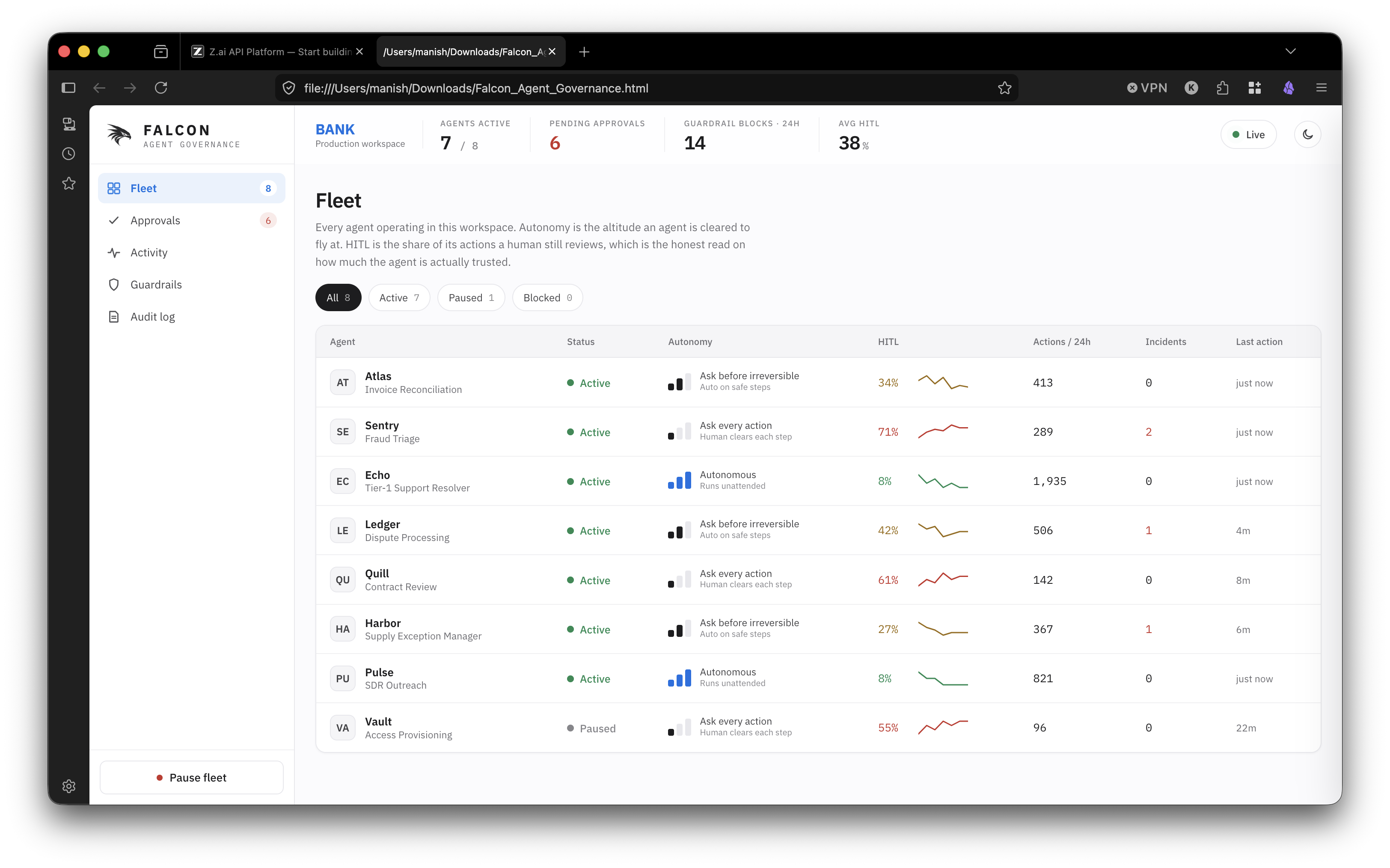
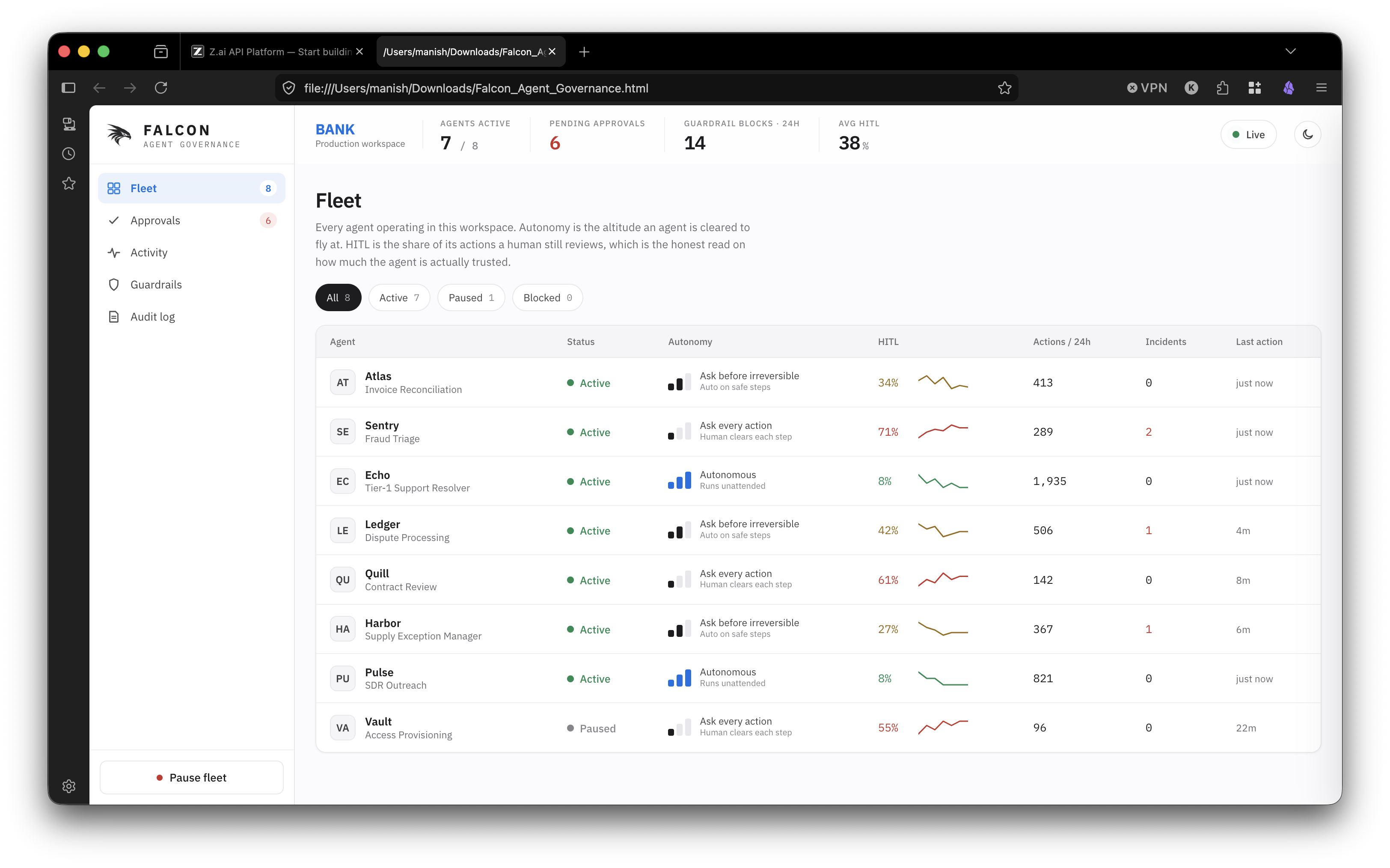 The Fleet view — exceptions first, routine compressedOpen prototype →
None of these are exotic. That’s the point. They’re the cards, modals, and tabs of the agentic era, and they generalize to any domain where an agent’s actions have real-world consequences, not just finance.
A three-position dial per agent (Ask every action → Ask before irreversible → Autonomous), visible at a glance in the fleet table and retractable in one tap. Altitude is a clearance, not a capability. The human holds the dial.
What each agent may touch and may not touch, written as a readable list rather than buried in a permissions grid. Every item affirmative or negative, in plain English. Authority as a first-class document.
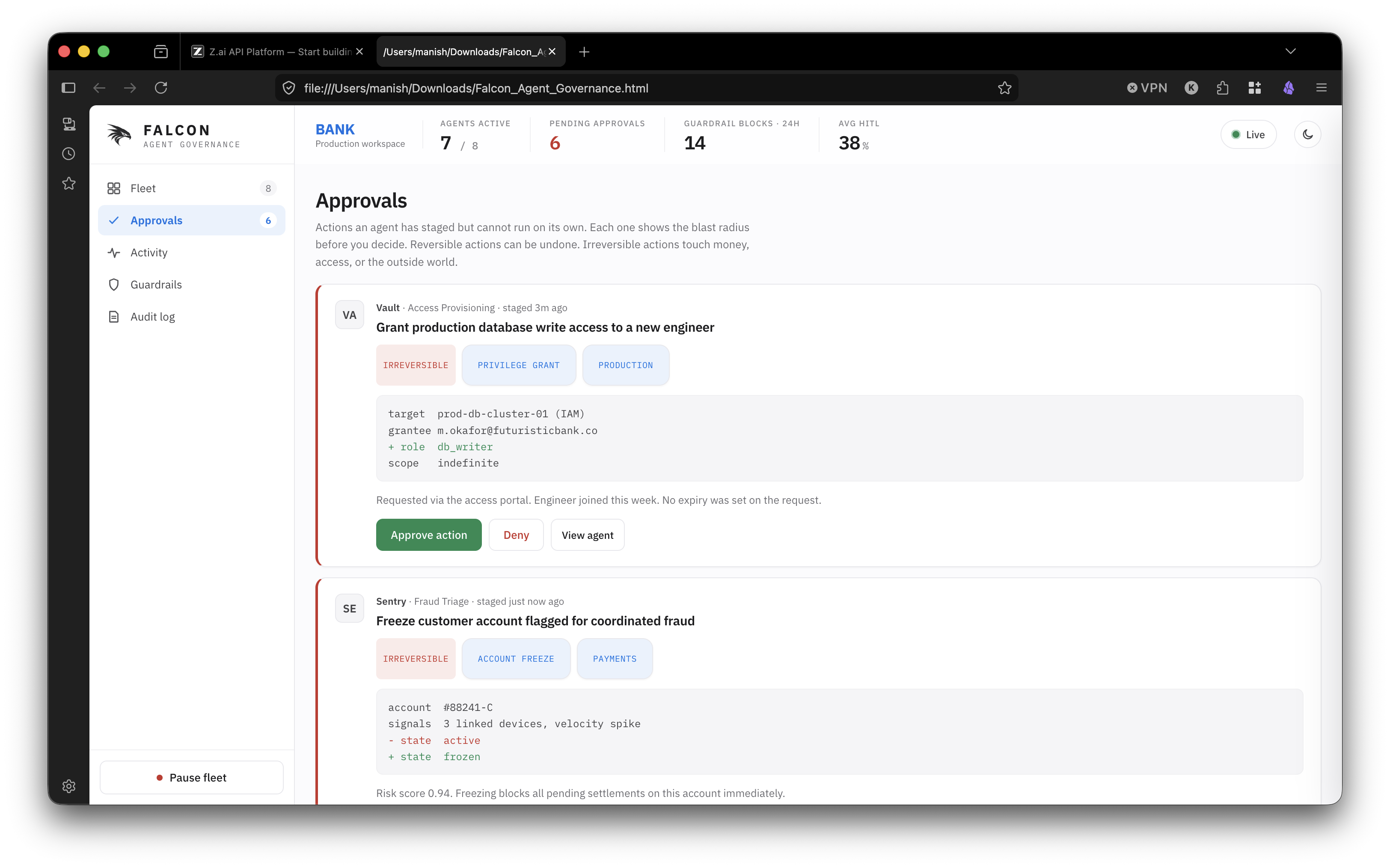
Before a human approves an irreversible action (freeze an account, post a journal entry, cancel a PO), they see a before/after diff of exactly what changes, a reversibility tag, and the context that surfaced it. Decisions on full information, not a summary.
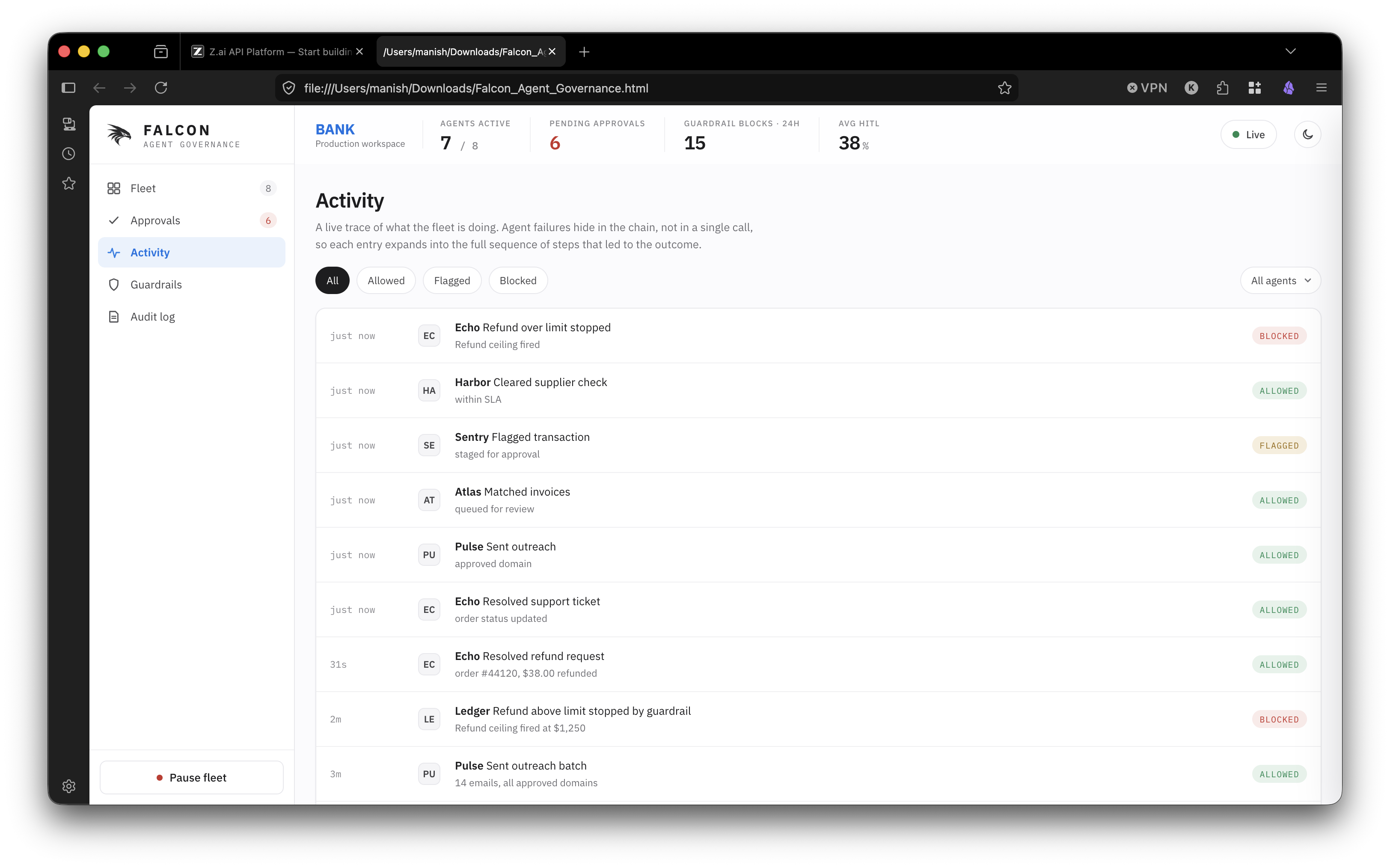
The approval queue foregrounds only what needs a human; routine success compresses to one quiet row, and failures expand into the full multi-step chain where the real fault lives. On a good day, the queue is empty and the feed is green.
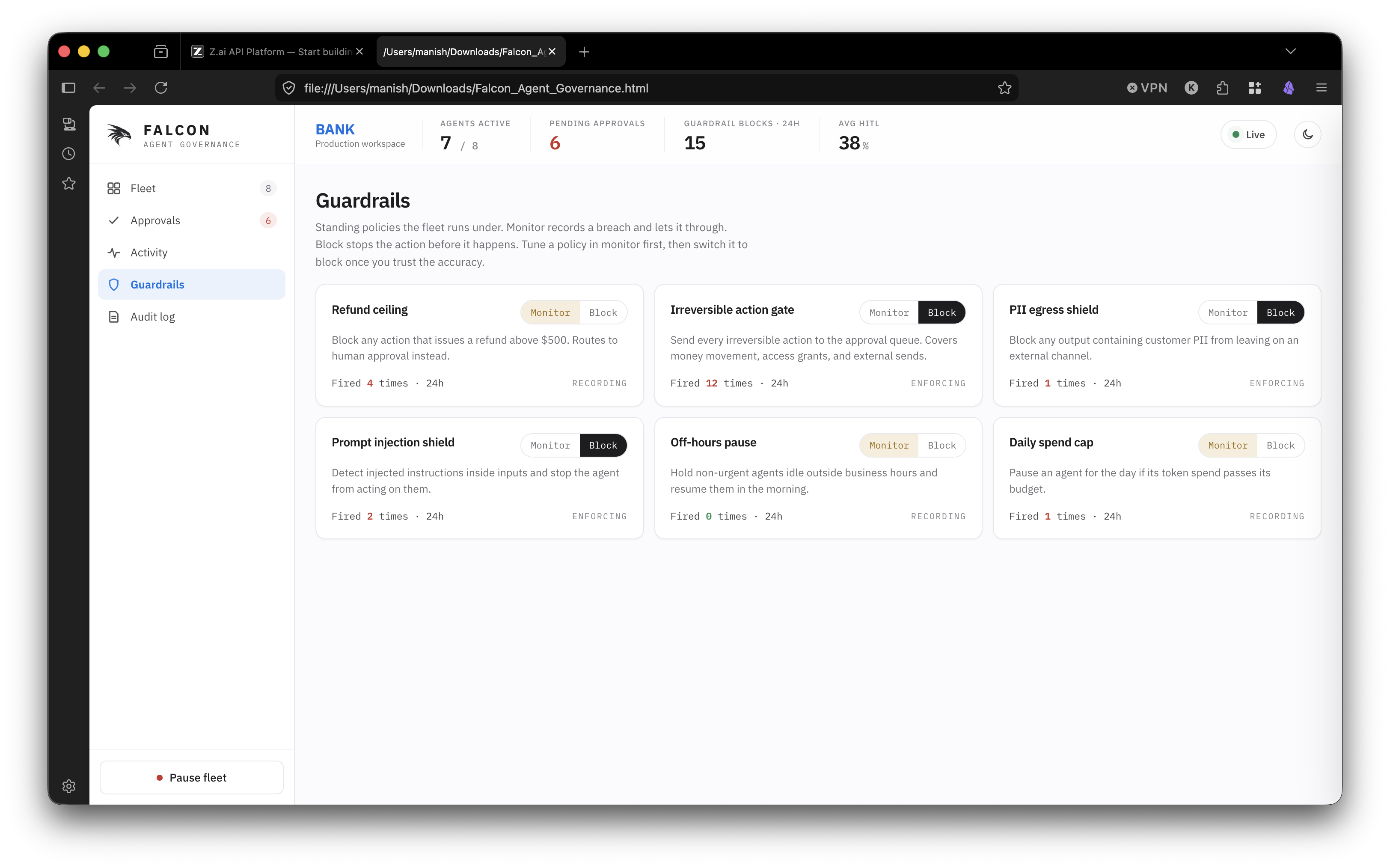
Guardrails toggle per policy between Monitor (record and allow) and Block (stop before execution). Tune in Monitor, verify accuracy, then switch to Block, a two-click transition, not a config-file edit.
Traditional enterprise UX treats the human as the operator, driving every action, with the system as a passive tool. Falcon treats the human as the principal, accountable for outcomes they no longer personally perform. That single reframe changes everything downstream.
Each screen demonstrates the patterns in context. Tap any to open the interactive prototype.
Senior product designer working across AI, FinTech, and complex product systems, with deep experience designing for major financial institutions. His work focuses on making powerful technology easier to understand, operate, and trust, especially where clarity, control, and human judgment matter.
The patterns here are free to learn from and build on. Attribution appreciated.